

FCL is usually the better option when:
- Your cargo volume is high
- LCL cost is close to full container price
- You want faster handling and lower risk
For shipments above 13–15 CBM, FCL is often more cost-efficient.
WhatsApp / WeChat
Withing 30 minutes
Your Cargo, our commitment
China to wordwide
See how much sea freight from China costs, compare container rates and transit times, and choose between FCL or LCL for your shipment.

Get reliable and updated shipping costs from China based on your cargo, container type, and destination.
We offer both full container (FCL) and shared shipping (LCL) options tailored to your shipment size and budget.
We manage sea freight from major China ports with optimized routes and predictable delivery times.
Trusted by importers for efficient and cost-effective sea freight solutions.
Sea freight from China in 2026 usually costs around $1,500–$2,100 for a 20ft container to Asia, $2,000–$2,800 to North America, and about $2,500–$3,400 for a 40ft container to the USA, Canada, or Mexico. For smaller shipments, LCL shipping from China is charged by volume, with typical rates around $60–$280 per CBM. The final price changes based on destination, cargo size, route, container availability, shipping season, and port conditions.
For low-volume cargo, LCL sea freight is usually the practical option because you only pay for the space your goods use. Once your shipment reaches around 13–15 CBM or more, FCL shipping from China can become more cost-effective because you book a full container and get better handling control. Typical transit times are 5–12 days within Asia, 15–40 days to North America, 25–45 days to Europe, and 18–30 days to Oceania. To calculate an accurate quote, the key details are CBM, cargo weight, pickup city, destination, container type, Incoterms, customs documents, and delivery terms.
Use this quick decision box to see if sea freight from China is the right option for your shipment. It explains estimated FCL and LCL shipping rates, container costs, transit times, quote factors, and what details are needed to get a real sea freight quote before booking.
Need current sea freight rates from China? Send your cargo details and we’ll check the right FCL or LCL option for your route.
Get My Sea Freight QuoteSea freight from China is usually the most cost-effective option for shipping large or non-urgent cargo, but the actual cost depends on several factors like destination, container type (FCL or LCL), and shipment volume. Transit time can also vary widely depending on the route and port conditions.
In this page, you can compare updated 2026 sea freight rates, understand how container shipping pricing works, and check estimated transit times based on your destination. This helps you choose the most efficient and cost-effective shipping option for your cargo.
At DDPCHAIN, we help importers plan and manage sea freight shipments from China with reliable rates and practical shipping solutions.
Download Free 2026 Guide to Sea Freight from China

Below, you can see the average price ranges for both FCL and LCL shipping from China in 2026. The tables give you a clear idea of typical shipping costs based on container type and destination.
| Continent | Countries Like | Cost |
|---|---|---|
| Asia | Japan, South Korea, Vietnam, Thailand, Malaysia | 1500–2100 USD |
| Middle East | UAE, Saudi Arabia, Qatar, Kuwait, Oman | 1650–2300 USD |
| Europe | Germany, UK, France, Netherlands, Italy | 1800–2600 USD |
| Africa | Egypt, South Africa, Kenya, Nigeria, Morocco | 1900–2700 USD |
| North America | USA, Canada, Mexico, Guatemala, Honduras | 2000–2800 USD |
| South America | Brazil, Argentina, Chile, Peru, Colombia | 2100–3000 USD |
| Oceania | Australia, New Zealand, Fiji, Samoa, Tonga | 1700–2400 USD |
| Continent | Countries Like | Cost |
|---|---|---|
| Asia | Japan, South Korea, Vietnam, Thailand, Malaysia | 2000–2600 USD |
| Middle East | UAE, Saudi Arabia, Qatar, Kuwait, Oman | 2100–2800 USD |
| Europe | Germany, UK, France, Netherlands, Italy | 2300–3200 USD |
| Africa | Egypt, South Africa, Kenya, Nigeria, Morocco | 2400–3300 USD |
| North America | USA, Canada, Mexico, Guatemala, Honduras | 2500–3400 USD |
| South America | Brazil, Argentina, Chile, Peru, Colombia | 2600–3500 USD |
| Oceania | Australia, New Zealand, Fiji, Samoa, Tonga | 2200–3000 USD |
| Continent | Countries Like | Cost |
|---|---|---|
| Asia | Japan, South Korea, Vietnam, Thailand, Malaysia | 3500–4200 USD |
| Middle East | UAE, Saudi Arabia, Qatar, Kuwait, Oman | 3800–4600 USD |
| Europe | Germany, UK, France, Netherlands, Italy | 4000–5200 USD |
| Africa | Egypt, South Africa, Kenya, Nigeria, Morocco | 4200–5300 USD |
| North America | USA, Canada, Mexico, Guatemala, Honduras | 4300–5400 USD |
| South America | Brazil, Argentina, Chile, Peru, Colombia | 4500–5500 USD |
| Oceania | Australia, New Zealand, Fiji, Samoa, Tonga | 3700–4800 USD |
| Continent | Countries Like | LCL Cost per CBM (USD) |
|---|---|---|
| Asia | Japan, South Korea, Vietnam, Thailand, Malaysia | 60 – 120 USD |
| Middle East | UAE, Saudi Arabia, Qatar, Kuwait, Oman | 80 – 150 USD |
| Europe | Germany, UK, France, Netherlands, Italy | 90 – 160 USD |
| Africa | Egypt, South Africa, Kenya, Nigeria, Morocco | 100 – 180 USD |
| North America | USA, Canada, Mexico | 120 – 280 USD |
| South America | Brazil, Argentina, Chile, Peru, Colombia | 140 – 260 USD |
| Oceania | Australia, New Zealand, Fiji | 90 – 170 USD |
If your shipment is above 13–15 CBM, FCL may be a more cost-efficient option than LCL, depending on the route and container rates.
💡 PRO TIP
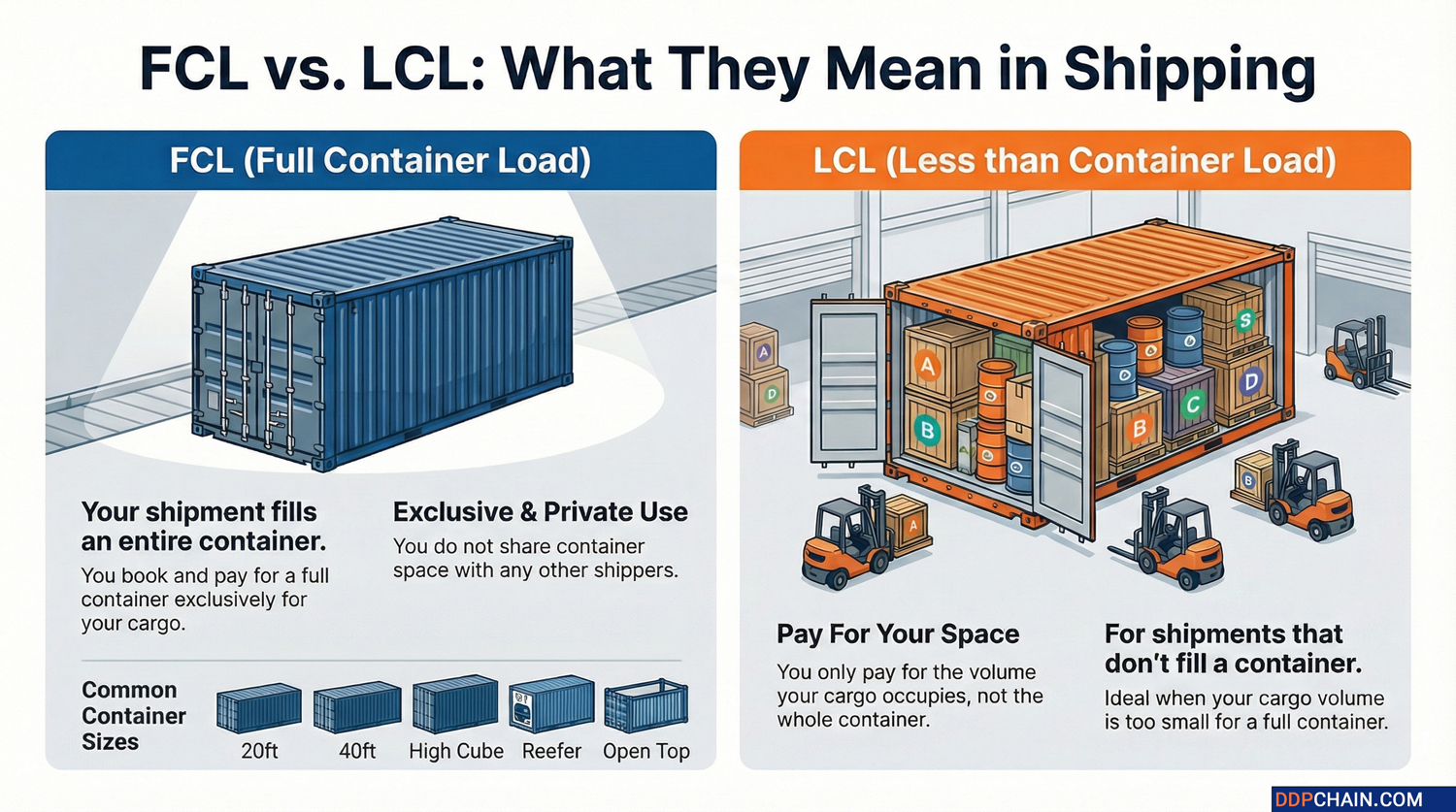
When shipping goods from China, one of the most important decisions is choosing between FCL and LCL service. This choice directly affects your shipping cost by sea, transit time, and how your cargo is handled during the process.
If your shipment is large enough to fill a full container, FCL (Full Container Load) is usually the better option. In this case, you book an entire container for your cargo only, which means faster handling, lower risk of damage, and more predictable delivery times.
On the other hand, if your cargo is smaller, LCL (Less than Container Load) allows you to share container space with other shipments. This reduces the upfront cost, since you only pay for the space your cargo occupies, which is calculated based on volume (CBM).
In simple terms, FCL is more efficient for larger shipments, while LCL is more flexible and cost-effective for smaller volumes. The right choice depends on your cargo size, budget, and how quickly you need the goods delivered.
FCL (Full Container Load) means your shipment fills an entire container, so you do not share space with other cargo. This option is commonly used for larger shipments where efficiency and control are more important than sharing cost.
You can choose from different container types depending on your cargo, including 20ft, 40ft, high cube, reefer, or special containers like open top and flat rack.
Because the container is used exclusively for your cargo, FCL shipping usually offers better security, faster handling at ports, and more stable transit times.
LCL (Less than Container Load) is designed for smaller shipments that do not require a full container. In this method, your cargo is consolidated with other shipments inside one container.
The cost is calculated based on volume (CBM), meaning you only pay for the space your cargo takes, not the entire container.
LCL is a good option if you want to reduce initial shipping costs, but it may involve slightly longer handling time due to consolidation and deconsolidation processes.
Choosing between FCL and LCL depends on your cargo size, budget, and delivery needs. The table below helps you quickly compare both options and decide which one fits your shipment.
| Factor | FCL (Full Container Load) | LCL (Less than Container Load) |
|---|---|---|
| Shipment Size | Large shipments | Small to medium shipments |
| Cost Efficiency | Better for high volume | Better for low volume |
| Transit Time | Faster and more predictable | Slightly longer due to consolidation |
| Risk Level | Lower (no shared space) | Higher (shared container) |
| Flexibility | Less flexible | More flexible for small cargo |
| Best For | Bulk cargo, high-value goods | Small shipments, cost-sensitive cargo |
👉 If your cargo volume is high, FCL is usually more efficient. For smaller shipments, LCL offers a more flexible and cost-effective solution.
A small change in how your cartons are packed can reduce total CBM and help you pay less for LCL shipping.
💡 PRO TIP
CBM means Cubic Meter, and it shows the total volume of your shipment. In sea shipping, especially LCL, CBM is the main factor that decides your final cost.
More CBM = more space = higher LCL cost.
CBM is used for both LCL and FCL, but it plays the biggest role in LCL pricing.
A small change in how your cartons are packed can reduce total CBM and help you pay less for LCL shipping.
💡 PRO TIP
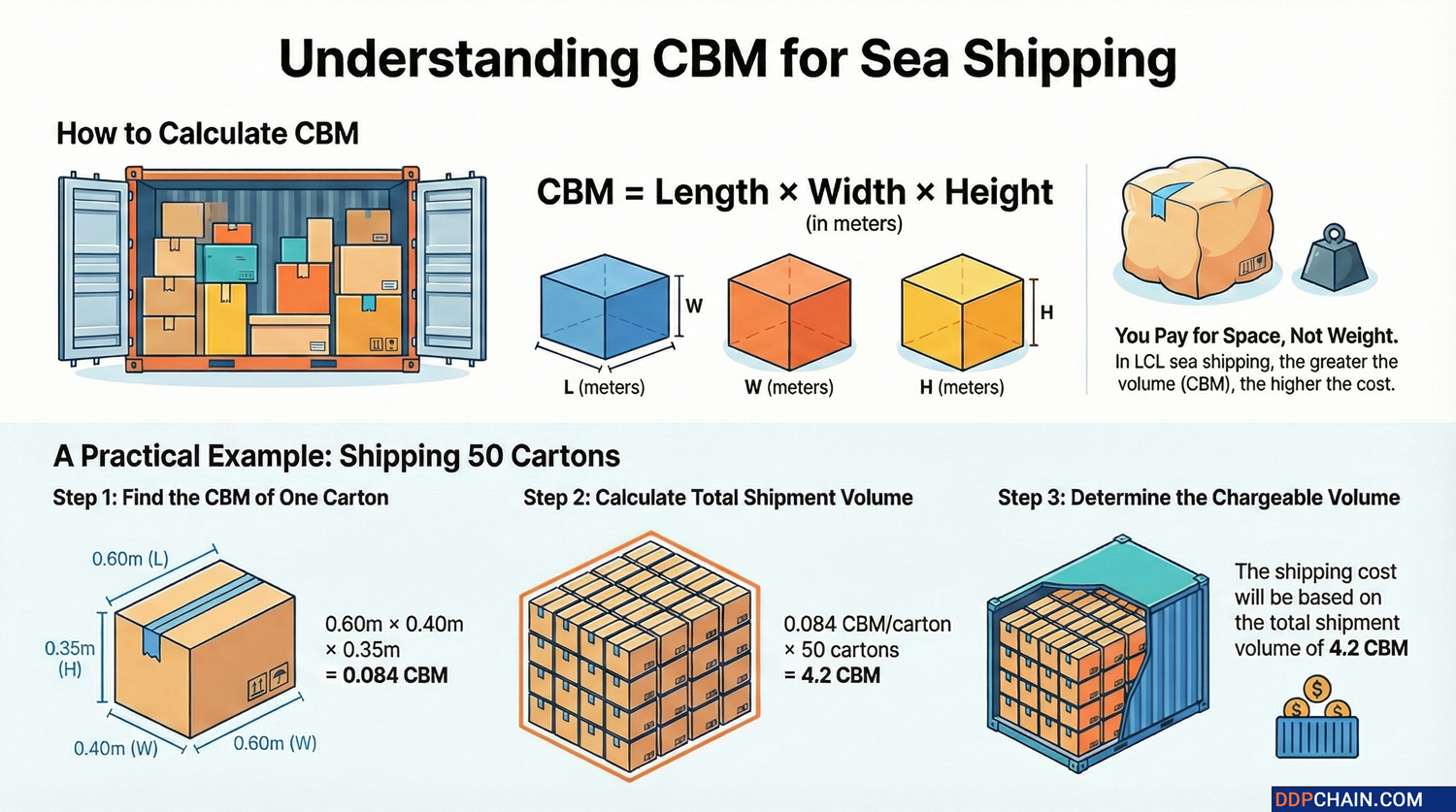
The formula is simple:
CBM = Length × Width × Height (in meters)
You must calculate CBM to know exactly how much space your cargo will take inside the container.
The bigger the total volume, the higher the shipping cost because in sea freight you pay for space, not for weight.
Example: LED Ceiling Lights
Imagine you are shipping 50 cartons of LED ceiling lights from China.
Each carton size:
1. CBM per carton
0.60 × 0.40 × 0.35 = 0.084 CBM
2. Total shipment volume
50 × 0.084 = 4.2 CBM
3. Chargeable volume for LCL
4.2 CBM
So if you ship these cartons by sea, the company will calculate the shipping cost based on 4.2 CBM, because volume matters more than weight in LCL service.
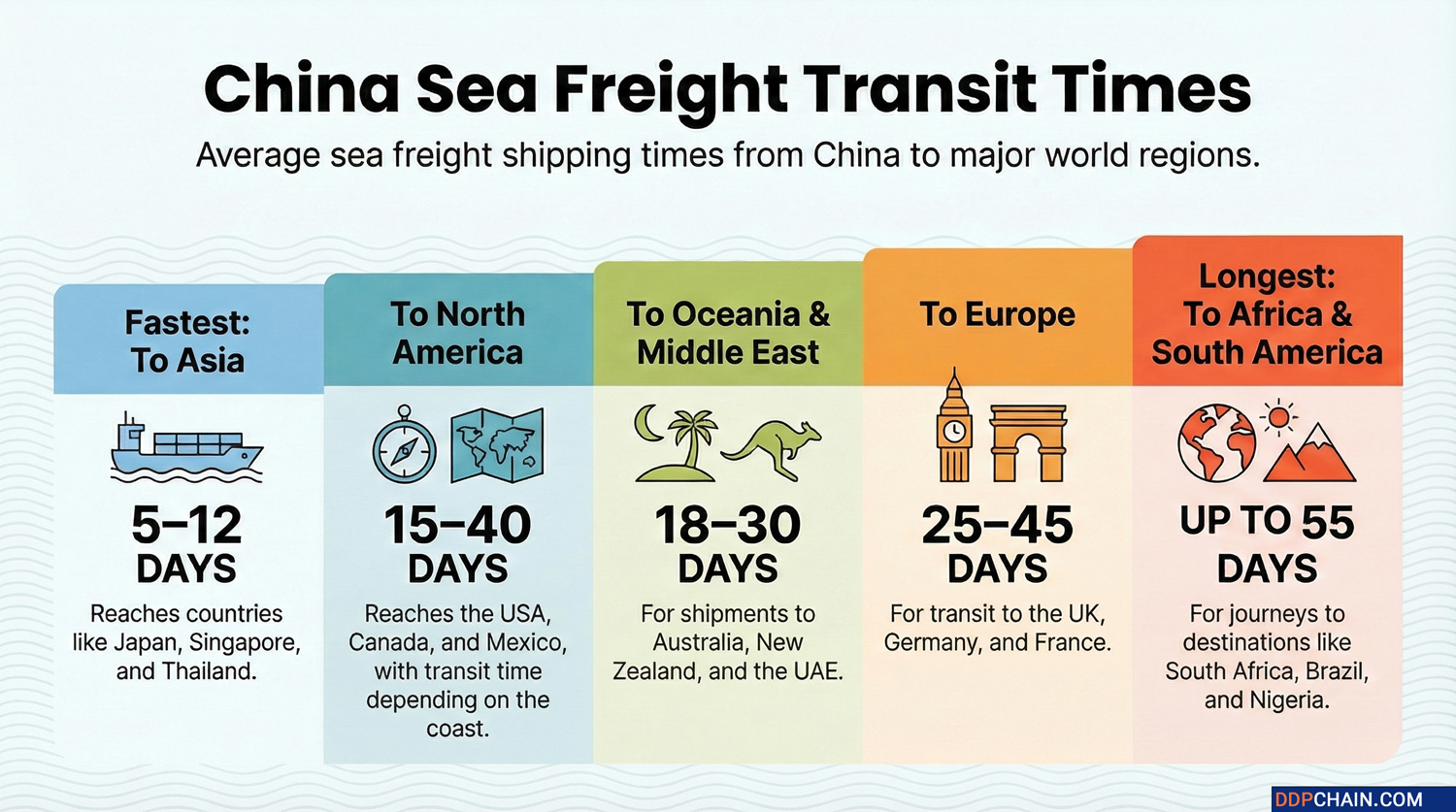
Sea freight transit time from China can vary widely depending on the destination, shipping route, and whether you choose FCL or LCL. For most shipments, delivery can take anywhere from a few days within Asia to several weeks for long-distance routes like Europe or North America.
Average Sea Freight Transit Times From China
| Continent | Countries Like | Average Transit Time |
|---|---|---|
| Asia | Japan, South Korea, Vietnam, Thailand, Malaysia, Singapore | 5–12 days |
| Middle East | UAE, Saudi Arabia, Qatar, Kuwait, Oman, Bahrain | 18–28 days |
| Europe | Germany, United Kingdom, France, Netherlands, Italy, Spain | 25–45 days (via Suez) |
| Africa | Egypt, South Africa, Kenya, Nigeria, Morocco, Tanzania | 30–55 days |
| North America | USA, Canada, Mexico, Guatemala, El Salvador, Honduras | 15–40 days depending on coast |
| South America | Brazil, Argentina, Chile, Peru, Colombia, Ecuador | 35–55 days |
| Oceania | Australia, New Zealand, Fiji, Papua New Guinea, Samoa, Tonga | 18–30 days |
In simple words:
Sea freight from China takes 5–12 days within Asia, 18–28 days to the Middle East, 25–45 days to Europe, 30–55 days to Africa, 15–40 days to North America, 35–55 days to South America, and 18–30 days to Oceania.
Sea freight shipping from China to any country is a great choice for traders. But to do it safely and without risk, you must manage every step carefully. The most important step in ocean freight is preparing the right shipping documents.
If you are a cargo owner, you need to know exactly what paperwork is required before your goods can leave the port.
Here is the simple checklist of documents you must get from your supplier before starting your sea freight process:
1. Packing List: This document shows all the physical details of your cargo. It must include the total size, packaging size, product weight, and the exact weight of your cartons and pallets.
2. Proforma Invoice: This is the bill from your supplier, showing the price and details of the goods you are buying.
3. Shipping Terms (Incoterms): This shows the shipping rules you agreed on with your supplier when you bought the goods (for example, FOB or EXW).
4. Certificate of Origin: You must ask your supplier for this document. It proves officially that your goods were made in China.
Choosing a Sea freight forwarder is not just about booking a shipment in China. It is about how smoothly the entire process is handled from the moment your cargo is ready until it reaches the final destination.
At DDPCHAIN, we focus on making sea freight from China simple and manageable by handling the operational side of shipping, so you don’t have to deal with multiple steps or unexpected complications.
We manage shipments from major ports such as Shanghai, Shenzhen, Ningbo, and Qingdao, allowing access to stable routes and regular vessel schedules.
Sea freight involves multiple steps, including supplier coordination, documentation, port handling, and delivery.
We handle the process from start to finish, so your shipment moves through each stage without delays or confusion.
Instead of a one-size-fits-all approach, each shipment is handled based on its specific requirements, ensuring a smoother and more predictable shipping experience.
Sea freight from China usually takes between 5 and 55 days depending on the destination, shipping route, and port conditions.
Typical transit times:
Transit time may increase during peak seasons or port congestion.
Shipping a container from China typically costs between 1500 and 3000 USD for a 20ft container under normal market conditions.
Factors affecting cost:
FCL and LCL are two different shipping methods:
FCL is faster and more secure, while LCL is more cost-effective for smaller shipments.
FCL is usually the better option when:
For shipments above 13–15 CBM, FCL is often more cost-efficient.
LCL shipping cost usually ranges between 80 and 180 USD per CBM depending on the destination and market conditions.
The final rate depends on volume, destination charges, and consolidation fees.
CBM (Cubic Meter) measures the volume of your shipment and is the main pricing unit for LCL shipping.
In simple terms:
To calculate CBM:
CBM = Length × Width × Height (in meters)
Steps:
This gives your total shipment volume.
You can choose from different container types:
The right container depends on your cargo size and type.
To compare sea freight rates:
This helps you choose the most cost-effective shipping option.
To get better shipping rates:
These factors can significantly reduce your total shipping cost.
Ask Your Question